
"DDoS" is one word in an incident log, and it covers attacks that share almost nothing. A volumetric flood can push terabits at your uplink. A slow attack can take a web server down from a single laptop by holding a few hundred connections open and sending kilobytes per minute. A defence built for one of them doesn't register the other.
This piece sorts DDoS attacks by the resource they exhaust, maps each class to the team or provider that owns the defence, and sets out how to test each one. It draws on the longer taxonomy published by our parent company at https://obsidio.com/types-of-ddos-attacks/
Why sort by resource
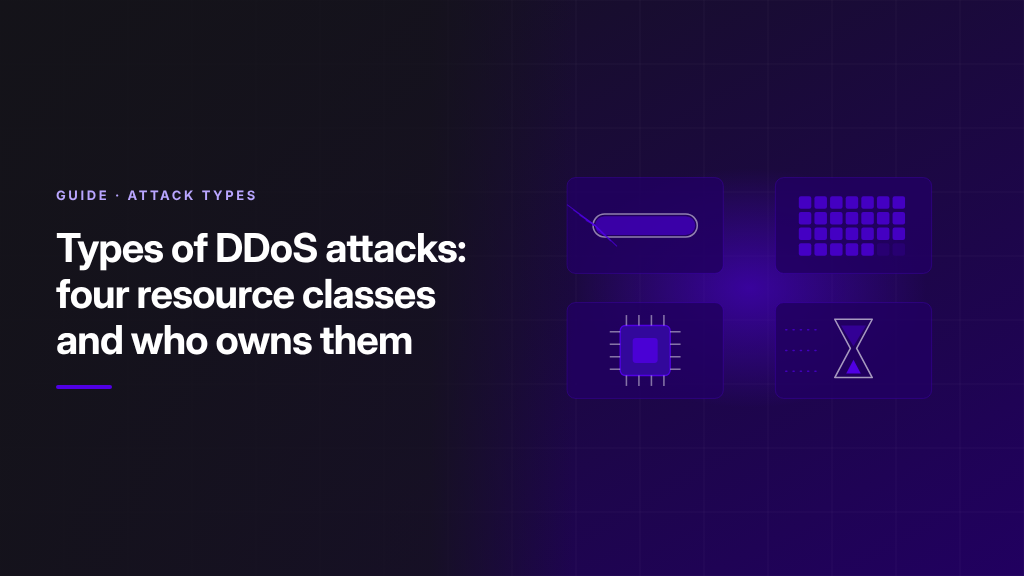
Attack names change every year, while the list of resources they drain stays short. Every DDoS attack runs one of four things dry:
- Bandwidth: the capacity of the links into your network.
- Connection tables: the state that firewalls, load balancers and servers keep for each connection.
- Application compute: the CPU, memory, threads and database connections your application spends on each request.
- Server patience: how long a server will wait on a connection that is sending almost nothing.
If you know which resource a scenario targets, you know which control should stop it and who is accountable for that control.
Class 1: volumetric (bandwidth)
Volumetric attacks fill the pipe. UDP floods, DNS floods and reflection or amplification attacks belong here. The traffic is too large to handle at your own edge, so the defence is upstream capacity: your transit carriers and your scrubbing provider, and how quickly they detect an attack and divert traffic.
The trend is upward. Cloudflare's DDoS threat report for H1 2026, as reported by Intelligent CIO Middle East, found that DNS floods rose from 25.7% to 40% of network-layer attacks between Q1 and Q2 2026, and that attacks above 1 Tbps grew 519% over the same period.
Owner: carrier and scrubbing provider, with your network and SOC teams owning detection and escalation on your side.
How to test: you don't reproduce this traffic yourself. Ask the provider for detection and diversion times, check them against the contract, and run a joint drill that tests escalation paths and on-call response. Reflection and amplification are outside our simulation scope for this reason.
Class 2: state exhaustion (connection tables)
Protocol and state exhaustion attacks target the tables that track connections. SYN floods, ACK and RST floods, floods of completed TCP connections, TLS handshake load and fragmentation attacks all sit here. The symptom is distinctive: CPU and bandwidth look fine, yet new users are refused because a table somewhere in the path is full.
Defences: SYN cookies, backlog and conntrack sizing, per-source connection limits, and stateful devices (firewalls, load balancers) sized for a realistic peak. A CDN or edge proxy only helps if the origin can't be reached directly around it.
Owner: the network team, plus whoever manages the load balancers.
How to test: verify SYN cookie and backlog settings through configuration review, since spoofed-source floods can't be safely reproduced from the internet. Then load completed connections from many real sources and watch connection-table counters on every stateful device. Check whether the origin answers on its own IP addresses.
Class 3: application layer (compute)
Layer 7 attacks send requests that look legitimate and cost the server real work. HTTP floods, cache-busting, floods from real browsers, requests that hit expensive search or report endpoints, and HTTP/2 abuse are all in this class.
Defences: WAF rules, rate limiting at the right granularity, caching, bot management, and protection for downstream resources like the database connection pool.
Owner: the application team and whoever runs the WAF or CDN configuration.
How to test: drive realistic request mixes at the costly endpoints (login, search, account statements, quote engines) from many distinct sources. A test from one or two IPs only shows that per-IP limits work against one or two IPs.
Class 4: slow attacks (patience)
Slow attacks hold connections open while sending as little as possible. Slowloris drips request headers. Slow-body variants drip the request body. Slow-read attacks accept the response very slowly. Each connection stays alive as long as the server lets it, and the server runs out of slots for real users.
Defences: timeouts with a minimum transfer rate, per-source connection limits, and full request buffering at the reverse proxy.
Owner: this often falls between teams. The settings sit in web server and reverse proxy configuration that may not have changed since deployment.
How to test: open slow connections from many sources and record when the server stops accepting new ones, and how fast it recovers once the test stops.
What this means for banks and telcos in the region
For GCC and Southeast Asian banks, customer-facing channels now sit in front of instant payment rails such as Aani in the UAE, sarie in Saudi Arabia and DuitNow in Malaysia. Telcos run self-care portals and APIs that customers use every day. These are application and connection-heavy services, which puts classes 2–4 squarely in scope, while many protection contracts and test programmes centre on class 1.
A practical review:
- List every scenario in your last DDoS test and tag it with the resource it targeted.
- Check that each of the four classes has a named owner.
- Ask your scrubbing provider for measured detection and diversion times, then drill them.
- Confirm that origin servers can't be reached around the CDN or edge proxy.
- Run connection, layer 7 and slow tests from enough real sources that per-source limits behave as they would under attack.
If the tags all say the same thing, the programme covers one class out of four. Our platform runs authorised simulations of completed-connection, layer 7 and slow attacks from a distributed network of real devices, with gradual ramp-up and live abort. Spoofed-source floods such as SYN floods stay with configuration review, and reflection attacks with your carrier and scrubbing provider.
To map your own test programme against the four classes, get in touch at https://obsidio.me/contact
Sources
Nader Salem is the regional partner for Obsidio in the Middle East and Southeast Asia.
← Back to Blog